
Neck Pain Relief In Great Dunmow, Royston & Saffron Walden
Learn more about your neck pain and how our team may be able to support you
Types of Neck Conditions
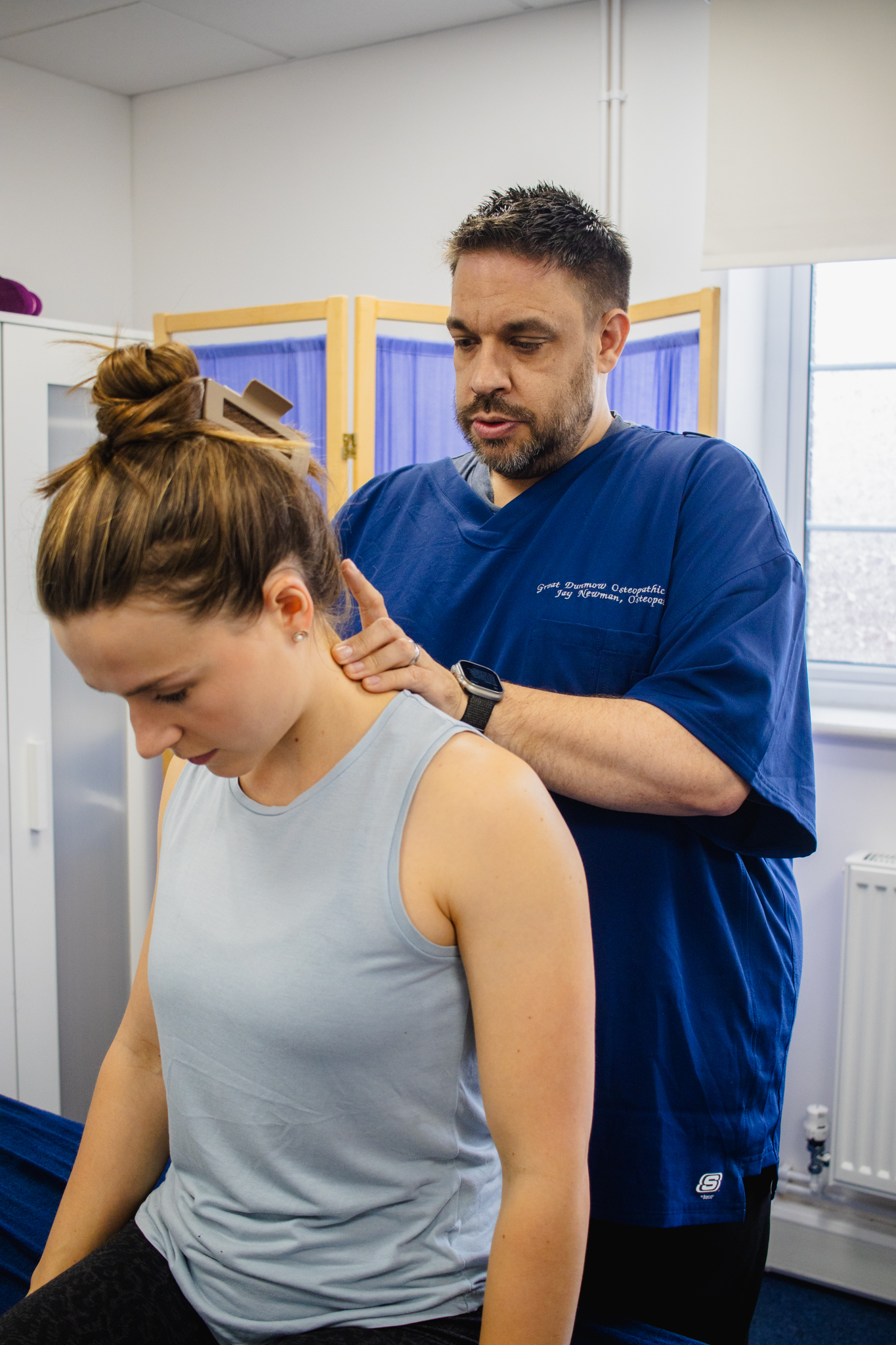
At our Great Dunmow, Royston & Saffron Walden clinics, we’re committed to helping you understand and manage a variety of neck discomforts. Below is a guide to some of the common neck issues we see, including their usual causes. At our clinic, we use a combination of osteopathic techniques and hands-on therapy to reduce tension, improve spinal alignment, and relieve pressure on the affected area.
Click on a condition below to learn more it.
Cervical spondylosis, or neck arthritis, is a common age-related condition that affects the joints and discs in the neck. As the cervical spine’s discs shrink and degenerate over time, bone spurs and other changes can develop, leading to stiffness, pain, headaches, and sometimes numbness, tingling, or balance issues if nerves are compressed. While often a natural part of aging, it can also be accelerated by repetitive strain or previous injuries.
Whiplash is a neck injury that occurs when the head is suddenly jolted backward and then forward, overstretching the neck muscles and ligaments. It most commonly results from rear-end car accidents but can also occur during sports, falls, or any incident causing rapid head movement. Symptoms may not appear right away but can include neck pain and stiffness, headaches starting at the base of the skull, shoulder or back pain, dizziness, fatigue, and even difficulty concentrating.
Cervical Radiculopathy, often called a “pinched nerve,” occurs when a nerve in the neck is compressed or irritated as it branches from the spinal cord, leading to pain, weakness, or other symptoms that radiate into the shoulder, arm, and hand. Common causes include herniated discs, bone spurs, and degenerative disc disease, all of which can place pressure on nearby nerves. Symptoms may involve sharp or burning pain, numbness, tingling, muscle weakness, or reduced reflexes, making everyday tasks difficult and sometimes interfering with sleep or work.
Torticollis, or “wry neck,” is a condition where the neck muscles contract involuntarily, causing the head to twist or tilt to one side. It can develop suddenly, leading to pain, stiffness, and limited range of motion, and may affect people of all ages, from infants to adults. Common causes include muscle strain from poor posture or awkward sleeping positions, congenital torticollis in infants due to positioning in the womb or birth trauma, and spasmodic torticollis, a neurological form involving chronic involuntary contractions. Symptoms often include neck pain, head tilt, raised shoulder on the affected side, and headaches, with severity ranging from mild discomfort to significant disability.
Spinal stenosis is a condition where the spinal canal narrows, putting pressure on the spinal cord or nerves. It most commonly affects the lower back or neck and can lead to symptoms like discomfort, numbness, or weakness. Causes often include age-related degeneration, herniated discs, past injuries, spinal tumours, scoliosis, or a naturally narrow spinal canal. These changes can reduce space around the nerves, leading to pain and reduced mobility.
Cervical disc herniation occurs when the gel-like centre of a spinal disc in the neck pushes through a tear in its outer layer, sometimes compressing nearby nerves or the spinal cord. This can cause neck pain, radiating pain into the shoulder, arm, or hand, as well as numbness, tingling, weakness, or reduced reflexes that interfere with daily activities. Common causes include age-related disc degeneration, repetitive strain from physical activity, and sudden trauma such as accidents or heavy lifting.
HOW IT WORKS
Our 3-step process to get you feeling better:
At your first appointment, we take the time to understand what's going on and learn more about you so that we can create a bespoke treatment plan designed specifically for you.
During your treatment, we combine physical therapies and the latest technologies to relieve your pain. This multi-disciplinary care provides you faster, more effective results.
With our care, you won’t just recover - you’ll develop lasting resilience. Our focus is on strengthening your body to reduce the risk of future setbacks & get you back to moving with confidence.
FREQUENTLY ASKED NECK PAIN QUESTIONS
We're here to help!
Neck pain is often caused by muscle strain, poor posture, degenerative changes in the spine, injuries, or conditions such as arthritis.
You should seek medical advice if neck pain is severe, persists for several weeks, spreads to the arms or hands, or is accompanied by numbness, tingling, or weakness.
Yes, spending long periods hunched over a computer, phone, or while driving can strain neck muscles and lead to pain and stiffness.
Applying heat or cold, gentle stretching, improving posture, and avoiding activities that worsen symptoms can help reduce discomfort.
Maintaining good posture, taking regular breaks from screens, using supportive pillows, and keeping neck and shoulder muscles strong and flexible can help prevent pain.

 Elaine Terry
Trustindex verifies that the original source of the review is Google.
I was lucky enough to see Charlotte about my old lady knees that have been dreadful lately and was fully expecting her to inform me that they need replacing. Instead she calmly and informatively explained what is going on and that by doing the exercises she fully demonstrated and got me to try and with regular ultrasound scans, I should regain full mobility with minimum pain. I will admit I was not particularly looking forward to the session, but after spending the time with Charlotte and having my questions answered thoroughly and being calmly advised, I am really hopeful that together we can help ensure I walk tall and hobble no more! Beth CracknellI have appointments here and it’s been a brilliant service, 8 years of pain from a car accident and 2 sessions of shockwave therapy and I can feel the difference!
 vincent thompsonExcellent service from Charlotte following a hip replacement which got me back to normal in record time. Many thanks. Vincent
 Nick BrownI struggled with plantar fasciitis for four months. A course of 6 sessions of shock wave therapy from Charlotte & Jason has made huge improvements. I'm back walking the golf course and largely untroubled by what was previously a chronic problem. I've received great care and treatment and would be happy to recommend.
 Kris YianniCurrently having treatment here for a plantar fasciitis issue and cannot recommend Charlotte enough. She is an absolute godsend and is amazing at what she does! Im having manual therapy currently and the pain is subsiding and im feeling soo much better after each session. Shes really knowledgeable and professional and im grateful for all the help she is providing me!
 Andrew GoodeyI’ve had 4 consultations with Charlotte due to my Knee and Plantar Fasciitis issues. So far, both are improving nicely Charlotte is both very knowledgable and friendly and manages to put one at ease with her easy going nature. Also impressed with the appointment reminders and the whole set up. I would certainly recommend to anyone Thanks Andy Goodey Rayne Braintree
 Tony & Diane BakerMy practitioner Charlotte, has continued the good work of this practice. Her observations of my stance and her listening capacity seem as important as the therapy she applies. In all these applied skills, find me at last in a good place. I have recommended her to my wife Diane and to a dear friend Shirley after a nasty fall in Spain. All will recommend Charlotte as their preferred Osteopath.. Grateful thanks. A. L. Baker.
 EA BI was assessed and by Charlotte who was really thorough and showed full understanding of my issue. Her treatment plan for me included shockwave therapy and exercises for me to do at home. I had sought help for plantar fasciitis from other professionals but Charlotte was by far the most thorough. I had 3 sessions and it has made a world of difference. I have recommended her to friends and I wouldn’t hesitate to seek her help again.
 Scott HFriendly staff and pleasant surroundings.
 Aaron WrightI’m 18 and a keen runner. After a big block of training I got a really stubborn knee injury that just didn’t seem to go away for months. I went to Great Dunmow Osteopathy & Health and did their knee pain programme which included focused shockwave therapy. I couldn’t believe how quickly the pain started to go away. That combined with a rehabilitation exercise programme Charlotte gave me meant I was pain free and back to running in just a few weeks! If you are in pain don’t waste anymore time, these guys will get you fixed very quickly.Verified by TrustindexTrustindex verified badge is the Universal Symbol of Trust. Only the greatest companies can get the verified badge who has a review score above 4.5, based on customer reviews over the past 12 months. Read more
Request a Free Phone Consultation
In pain? Got questions? Fill in your details below to arrange a free telephone consultation with our experienced team, to find out more about you and see how we might be able to help.

Professional, friendly and very helpful. I’m kept informed of appointments. I have been going for sometime and each time I have been treated respectfully and offered information on my body function and exercises that will help. A great team.
Message Sent Successfully!
Thank you for your message. We'll get back to you as soon as possible to schedule your free phone consultation.
Location
We have three convenient locations, all situated in the heart of their town centres. One is in Great Dunmow, just a 2-minute walk from Chequers Lane car park. Another is at Upton House in Royston. Our newest clinic, at Winstanley House on Market Hill in Saffron Walden, opens in August 2026. For patients with limited mobility, parking is available on site at our Dunmow location – simply give us a call or email in advance, and we’ll reserve a space for you.